
 Much like its neighbor to the north, Belize, Honduras has a natural beauty and laid back lifestyle that makes it very appealing to travelers. Unfortunately, its restless political history and underdeveloped infrastructure keep most tourists away. The country was devastated by Hurricane Mitch, which hit in October of 1998, but relief efforts have helped renew the tourist interest in this rough but enticing country.
When traveling in Honduras, be aware that street crime is a problem throughout the country. Armed robbery, purse snatching, and pickpockets are on the rise, especially in the larger towns and cities like San Pedro Sula and Tegucigalpa. The areas near Tela and Santa Rita de Copán–including the El Rubi waterfall–can be extremely bad with reports of robberies, assaults, and even rapes. When traveling in Honduras, use extreme caution and practice common sense.
Traveling in Honduras
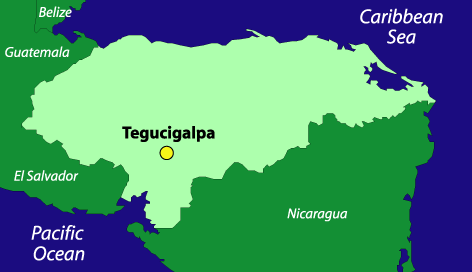 Flying to any of the bay islands from the major cities is easy. Even flying to the remote areas is getting easier each year. Most larger towns have buses that run from morning until evening. There are trains from San Pedro, Puerto Cortés, and Tela, but they can be slow and unpredictable, so it’s best to check schedules often. Launches run between the mainland and the bay islands, but again, schedules vary. You can also take a taxi, but they are not metered so make sure you negotiate a fare before you go anywhere. Rental cars are available and can be a good way to travel if you can deal with dusty roads in the dry season and wet, possibly washed-out roads during the rainy season. Hitch hiking is common in many rural areas where trucks will usually stop and pick you up, but it’s best not to do this alone.
Honduras is quite affordable. Travelers can get by on as little as US$20-$30 a day, and traveler’s on a buget can often do it for much less. Most businesses deal only in lempiras, the country’s currency. American dollars are easiest to exchange, though Canadian dollars and pounds stirling can be changed at Lloyd’s Bank in Tegucigalpa.
Health Risks in Honduras
Health risks include cholera, dengue fever, malaria, hepatitis, typhoid, and dysentery. It is advised that you consult a doctor about what shots you may need before traveling to Honduras.
Weather in Honduras
Weather in Honduras can be unpredictable. From the cool mountains of the interior to the rainy days along the coast, it can vary greatly. Between May and October can be especially rainy in the mountains; it rains almost daily year round on the coast.
Honduras Information
 Population: 6,249,598
Government: Constitutional democracy
Square Miles: 43,870 sq mi (112,492 sq km)
Capitol: Tegucigalpa (pop over 1 million)
Official Languages: Spanish, Creole English and Indian dialects
People: 90% mestizo, 7% Indian
Religion: Predominantly Roman Catholic, plus other Christian sects and indigenous forms of worship
Major products/industries: Coffee, bananas, beef, sugar cane, tobacco, forestry
 Cross the Rio Grande heading south and you’ll enter the United States’ southern neighbor Mexico. Mexico is a land of many contrasts, from the northern desert to the rainforests of Chiapas, and everything in between. This is a country filled with history and culture–one look at the Mayan ruins is testament to that–but it is also rife with isolated beaches, towering volcanoes, and glitzy resorts in places like Acapulco and Cancun. Whatever your passion, you’ll likely find it in Mexico.
 When the British withdrew from the Gulf in 1971, a group of seven shaikhdoms from the area united to form the United Arab Emirates (UAE). The UAE has been growing as trading and travel destination, with its mountains, beaches, and deserts, and its welcoming attitude toward Westerners, as well as Easterners. The UAE is known for its dichotomous lifestyle: on the one hand, there are soaring skyscapers with all of the world’s biggest banks represented and bustling shopping malls around every corner, on the other hand there’s plenty of shopping to be done in traditional Bedouin markets (or souks) and traditional cultural activities such as camel racing–legacies of the days before the boom. But while the UAE is considered one of the safest places to travel in the region, it is advised that you steer clear of political gatherings or demonstrations.
 While Indonesia’s spectacular beaches, natural resources, and laid-back lifestyle have attracted tourists, missionaries, and businesses for generations, recent political and religiously motivated events make much of the archipelago dangerous for Western tourists.
 Costa Rica has long been seen as an “eye of the hurricane”–a peaceful nation situated in the center of an often turbulent region. The rich history and well-preserved and diverse environment attracts tourists from around the globe. From its beautiful beaches to its massive rainforest, teaming with wildlife, the Costa Rican government has long been committed to preserve the country’s reputation as a environmentally and user-friendly place to visit.
 Venezuela is a gloriously beautiful country, and with almost 2000 miles of coastline, mountains, and jungle, there is something for everyone. Sites like Angel Falls, the world’s highest waterfall, and Lake Maracaibo, South America’s largest lake, ensure that you won’t soon forget Venezuela’s natural beauty. This is a country of extremes–just check out the giant anaconda for proof; it’s the world’s longest snake, capable of devouring a 100-pound tapir, or even a human, in a single meal.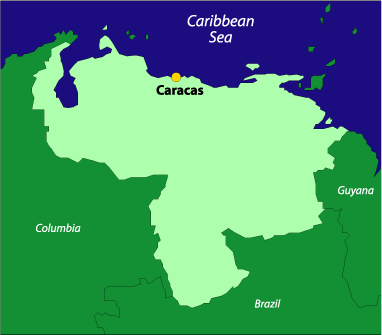

 Compared with the rest of volatile Central America, Belize is more like the island nations of the eastern Caribbean than it’s mainland neighbors. Its laid back way reminds visitors of the way the Caribbean was in the days before the big resorts.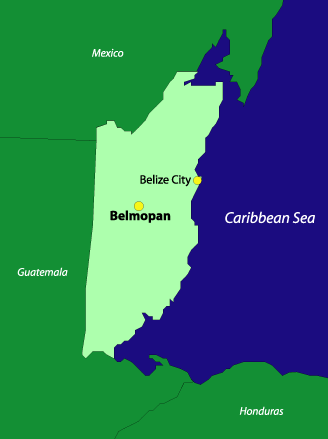
 Ireland is more than just the land of Guinness and Shamrocks, it is a land of mythic beauty that is hard to forget. From the ancient Celts to the early European Christians, Vikings, and finally the Normans, Ireland has seen more history than many other places on earth. But the country has emerged from tumultuous past into the modern world as a leader in technology and economic development. The Irish have come a long way over the past few generations, but don’t let the new modern ways fool you–you can still expect to find that good old Irish hospitality all over the country.

 As near to out-of-this-world as only a few habited places on this earth are, Bangladesh challenges the visitor to find fulfillment despite excessive population density, national poverty, and robust environmental extremes. The rewards for those who take on such a challenge, though, are unique and intriguing insights into the rich regional Bengali culture and the current state of South Asian and global society.


