
 Turkey is truly the meeting place of Europe and the Middle East. Although, generally, Turkey is considered a middle eastern country, its main hub Istanbul has a European feel with old world charm. This bustling city is a doorway into a country that has two distinct sides.
Turkey is rapidly entering the modern world, and may very soon be part of the European Union. This will take the country into a new phase and could open its doors even wider to tourism and economic growth. Turkey is a wonderful place to visit–whether walking through the old city of Istanbul or strolling down the ancient streets of Ephesus, you begin to understand what an important crossroads Turkey has been throughout history.
Turkey Information
 Population: 65.7 million
Government: Federal Republic
Square Miles: 483,260 sq mi (779,452 sq km)
Capitol: Ankara (pop 3.7 million)
Official Language: Turkish
People: Turks (85%), Kurds (12%), other Islamic peoples, Armenians, Jews
Religion: Muslim
Major products/industries: Agriculture, motor vehicles, petroleum, engineering, tourism
Traveling in Turkey
Turkish airlines can fly you to most all Turkish cities, but there are other cheaper ways to move around Turkey. Turkish buses are good way to travel through the country–they are cheap, comfortable, and they go everywhere. Trains are a good value if you plan on traveling long distances overnight, if you can get a sleeping compartment, but they don’t travel as frequently or cheaply as buses. If you plan are driving, make sure you have plenty of insurance and nerves of steel. Turkish drivers are famous for their speed and aggressiveness, so driving is not recommended. Taxis are recommended over driving, but if you do happen to be driving and want to avoid getting behind the wheel more than you have to, there are automobile ferries that can bring you down the coast during the summer.
Weather in Turkey
Turkey is a great place to travel in the “shoulder” seasons of spring and fall, when the weather along the coast is best. In the summer the weather can be uncomfortably hot and in the winter the coastal areas are essential closed.
Turkish Cuisine
Most places in Turkey you’ll find cuisine not unlike that in the United States. Chicken and lamb seem to be on all menus, often heavily tenderized and breaded. Entrees don’t tend to have heavy sauces on them, but that doesn’t mean they don’t have a lot of taste. Most meats or poultry in Turkey are prepared with a lot of spices, which gives the food some flare. On the whole, restaurant meals are reasonably priced, and if you plan on eating out in Istanbul, finding a good inexpensive meal usually means little more than walking down the block from your hotel (hotel restaurants are typically overpriced and less representative of true local cuisine).
What to Know
TurkeyThere is a lot to see and do in Turkey and it is best to research where you would like to go beforehand. It is a large country and seeing what you want in one visit may not be possible, but making sure you get to see Istanbul as well as some of the famous historical sites like Esphesus or Troy should be high on the list.
 When the British withdrew from the Gulf in 1971, a group of seven shaikhdoms from the area united to form the United Arab Emirates (UAE). The UAE has been growing as trading and travel destination, with its mountains, beaches, and deserts, and its welcoming attitude toward Westerners, as well as Easterners. The UAE is known for its dichotomous lifestyle: on the one hand, there are soaring skyscapers with all of the world’s biggest banks represented and bustling shopping malls around every corner, on the other hand there’s plenty of shopping to be done in traditional Bedouin markets (or souks) and traditional cultural activities such as camel racing–legacies of the days before the boom. But while the UAE is considered one of the safest places to travel in the region, it is advised that you steer clear of political gatherings or demonstrations.
 Much of early history centers itself around an area known as the “Fertile Crescent,” referring to the land between the Tigris and Euphrates Rivers in present-day Iraq. Many ancient kingdoms were borne out of this region, including the Assyrians, Sumerians, and Babylonians–whose legendary King Hammurabi penned the enormously important Code of Hammurabi, one of the most significant legal doctrines of all time.
 The sultanate of Oman is a land of friendly people and magnificent landscapes–so the world is finding out as this corner of the Middle East emerges from a long period of isolation. Oman is one of the most traditional countries in the Middle East, but as it slowly comes out of its shell, it’s beginning to look more toward the future than the past.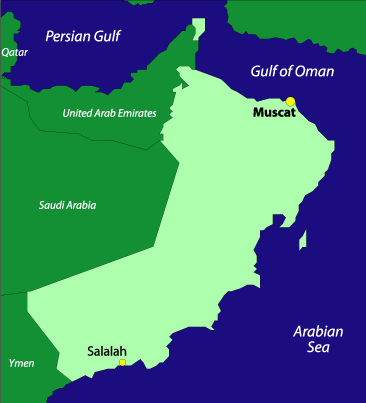
 Population: 2.5 million
 Ireland is more than just the land of Guinness and Shamrocks, it is a land of mythic beauty that is hard to forget. From the ancient Celts to the early European Christians, Vikings, and finally the Normans, Ireland has seen more history than many other places on earth. But the country has emerged from tumultuous past into the modern world as a leader in technology and economic development. The Irish have come a long way over the past few generations, but don’t let the new modern ways fool you–you can still expect to find that good old Irish hospitality all over the country.
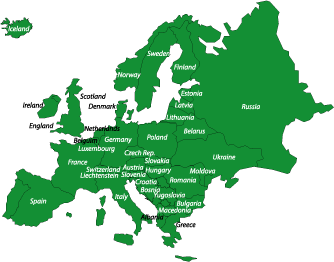
 Switzerland, sometimes referred to as the “island inside Europe,” is a land with many identies. From its busy banking centers in the cities to the lovely mountains and Alpine villages, Switzerland is also a land of many contrasts. The robust culture of this country is exemplified by the four different languages spoken by its population: German, French, Italian, and the native Romansch.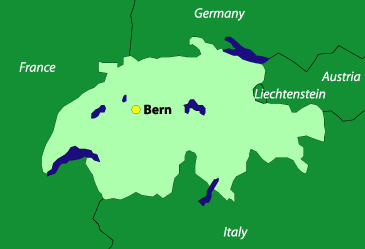
 The weather in Switzerland can vary a tremendously. Due to its rugged geography, Switzerland has many microclimates; you can leave one beautiful sunny place only to travel a half-hour away and find it cloudy, cold, and overcast. The southern part of the country gets more of the Mediterranean climate, while the rest of Switzerland tends toward conditions more typical of central Europe, with temperatures in the summer reaching 20° to 25°C, and 1° to 5°C in the winter.
 The islands that make up the United Kingdom probably broke off of the mainland of Europe about 8 millennia ago. Orginally occupied by little-known tribal cultures, some of whom are thought to have built Stonehenge, the island region was invaded by the Celts around 500 BC. These Celtic invaders drove most of the island communities into the areas that now make up the Scottish Highlands and Welsh mountains. In 54 BC, Juluis Caesar set up a ruling government in the southern regions and built roads, towns, and fortresses. During this time, various religions were introduced and agriculture and trade flourished. England–the area of the United Kingdom encompassing the southern and southeastern portion of Great Britain (south from roughly the Cheviot Hills in Scotland and east from roughly the eastern foothills of the Cambrian Mountains in Wales)–is a land slow to transform into the 21st century; still, modern-day England is a far cry from the England of the mid-20th century. The country wants to promote its old-world hertitage with a new-world flavor. More and more, the royal family seems to fade from the public eye, replaced by actors, artists, musicians, and “celebrity” politicians.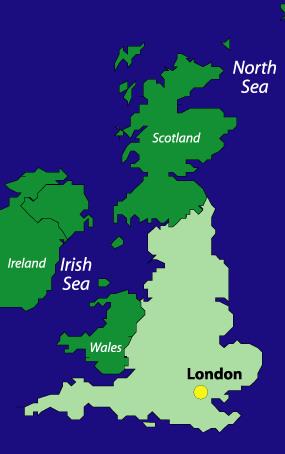
 Once you get out of the city, costs will drop, particularly if you have a transport pass and if you cook your own meals. You’ll still need at least US$30 a day, and if you stay in B&Bs, eat one restaurant meal per day, and don’t skip out on courtesy entry fees, you’ll need about US$65 a day.
 The newly independent nation of Georgia is hard to describe in terms of one particular region. Some consider it part of the Middle East, others Europe, and still others Asia. The reason for this may be because it is so closely related, both geographically and culturally, with all of these places. Once it broke from the former USSR, Georgia suffered some civil unrest, but as the situation stablizes, Georgia is becoming a major player in world affairs.
 The 9th-century founding of Novgorod by the Viking Rurik initiated a more than thousand-year history of wealth and war, trial and loss, conquest, Communism, and tyranny. The monarchic splendor and seething peasant ideology of old Russia, coupled with the complex social, economic, and political changes brought about during the Soviet era, survive today in one form or another in what is possibly the most enigmatic yet of this country’s many incarnations.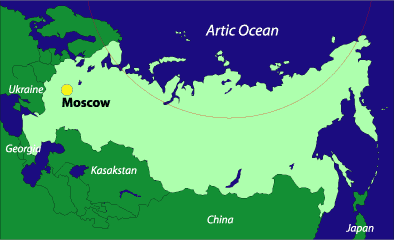
 Ancient history melds with cutting-edge technology; long, rainy, or freezing winters contrast against vibrant, endless days of summer. Such are the complexities of Scotland, a land where the gloomy weather very often belies the sunny dispostion of her people.
 But Scotland isn’t just for escaping. The cities have lots to offer as well. Edinburgh is a thriving metropolis, banking and academic center, and home to the Royal seat in Scotland–the Palace of Holyroodhouse. There are a number of notable museums, such as the Scottish National Portrait Gallery and the National Gallery of Scotland, as well as unique and beautiful parks like Calton Hill (home to a number of Scottish monuments), Arthur’s Seat at Holyrood Park, Edinburgh Castle, and the Royal Botanic Garden. Take a stroll down the Royal Mile or through New Town and you’ll find pubs, shops, restaurants, and accomodations that will suit your mood. Glascow is a very different kind of city. This one-time shipbuilding capitol has weathered the storms of recession and come out the other side with a fresh, new perspective. Glascow is known for its art, design, and architecture. It’s a decidely more modern city than Edinburgh, and as such, it attracts a great deal of younger people. Make your way to Sauchiehall Street for all of your shopping, eating, and drinking needs; but don’t miss the history that Glascow has to offer too. In the eastern part of the city you’ll find the gothic Glasgow Cathedral, St. Mungo’s Museum of Religious Life and Art, and Provand’s Lordship (built in the 15th century, it’s the oldest house in Glascow). Another interesting attraction is the Tenement House museum–offering a window into middle-class life around the turn of the 20th century.