Panama has a checkered past, but as a modern country it runs one of the world’s most important waterways, the Panama Canal, and has built for itself a large offshore investing business. From its capitol at Panama City to its rainforests and rich coastlines, Panama is a beautiful land, but it suffers from increasing crime and an uncertain government.
Panama is a proud and striking nation with a population of seven indigenous groups and a strong Spanish legacy. And it’s is a wonderful place to travel, as long as you’re careful and conscious of your surroundings.
If you want to see Panama at its cultural best, Carnaval is celebrated the weekend before Ash Wednesday in Panama City. It’s one of the largest and most vibrant Carnaval celebrations in the world.
Traveling in Panama
If you are an American, Japanese, New Zealander, or Venezuelan citizen, it is required that you have a tourist visa or tourist card to enter Panama. You should contact your embassy or consulate for details.
While traveling in Panama is considerably cheaper than traveling in the United States, for instance, it will also tend to be pricier than most other Central American countries. Expect to pay about US$20-30 per day, on a moderate budget, for 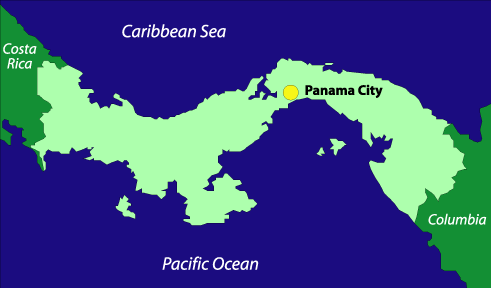 food, accommodations, and other expenses. A budget traveler can find room and board for as low as US$10-15 per day. The Panamanian currency is called the balboa, but it’s exactly the same as the U.S. dollar, from the rate of exchange (which is unnecessary if using U.S. currency) all the way to the bills they use. Even the coins are the same shape, weight, and substance as U.S. coins. Exchanging other types of currency can be easily done at a casa de cambio, of which there are many throughout the small nation.
Tipping 10% of your bill can be done at finer restaurants; however, it’s not necessary at more casual establishments, such as cafes. Haggling over goods is not customary in Panama.
Health Risks in Panama
Health risks include dengue, hantavirus, malaria, rabies, and yellow fever. It is advised that you consult a doctor about what shots you may need before traveling to Panama.
Weather in Panama
The best time to go to Panama is during the dry season, between December and April. During the rainy season the weather can be humid, damp, and very uncomfortable, especially if you take part in strenuous activities like hiking, etc. The rain in Panama typically comes in short downpours that have a cooling and cleansing effect on the air.
Panama Information
Population: 2,800,000
Government: Constitutional Republic
Square Miles: 30,420 sq mi (78,000 sq km)
Capitol: Panama City (pop: 700,000)
Official Languages: Spanish, English, and Native languages
People: 65% mestizo, 14% African descent, 10% Spanish descent, 10% Indian
Religion: 85% Roman Catholic, 10% Protestant, 5% Islamic
Major products/industries: Banking, construction, petroleum refining, brewing, cement and other construction materials, sugar milling, shipping, and agriculture
 Just because Canada borders the U.S. doesn’t mean it is like the U.S. The eastern parts of Canada, such as Quebec and Ontario, are modern and sophisticated; while the west and north are still somewhat wild, and often seem untouched compared to the United States and Europe.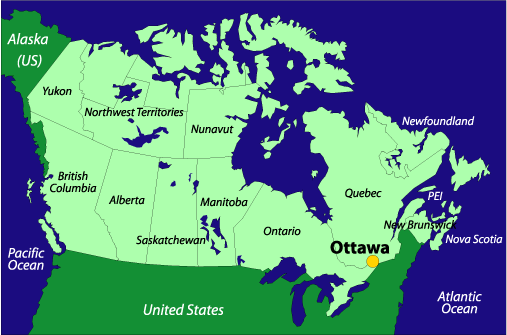

 St. Lucia, which is one of the bigger islands in the Windward Island chain of the lower Caribbean, has done what most of the Caribbean islands have done after the tapering off of their once rich agriculture and exports industries: turned itself over to tourism. After the sugar industry collasped the islands of the Caribbean struggled to get by until airplane travel made visiting these once remote outposts just a few flight connections away. There are still some old fishing villages mixed in among the resorts and charter sailboat operations, but the main industry now is tourism and service.
 To understand more about this troubled Central American country one only needs to watch the movie Salvador, about the brutal civil war that tore the country apart in the 1980s. The civil war is now over in El Salvador, and its beauty and splendor–including active volcanoes and cloud forests–are starting to show again.
 After more than three decades of civil war, Guatemala is now emerging as a viable and popular tourist destination. The breadth of Central America’s ecology, culture, and history can be found in Guatemala in a distilled form: ancient Mayan ruins and soaring volcanoes stand side-by-side, and the government’s tourism-focused agenda has encouraged a rich and educational lexicon of Mayan history to arise.
 “The land of the free and home of the brave.” This is the motto of the United States, but “free” has nothing to do with traveling there. Hotels, campgrounds, and national parks will all cost you if you want to go. Of course, this doesn’t mean traveling in the U.S. is impossible without loads of cash. Road tripping and staying with friends is just one way to save on the costs associated with being in America, and there is so much to do and see there, you can be virtually anywhere in the country and still have many interesting opportunities open to you. Whether you’re looking for islands, mountains, or historical heritage, the United States has it, and it’s never far from where you are.
 This is beach country! Located in the Caribbean British Leeward Islands, Antigua, Barbuda, and Redonda, all make up the single nation of Antigua & Barbuda. Antigua alone, being the largest of the British Leewards, claims upward of 300 beaches with plenty of room to bask in the sun, swim, dive, sail, and more. There are reefs and wrecks abound, for underwater exploration, as well as many sites on shore, for those less inclined to the water.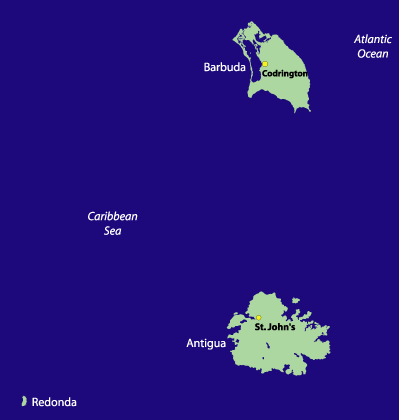
 AntiguaThe best (and busiest) time to go to Antigua is during the (NH) winter: December through February. The daily highs average around 81°F, and the skies are typically clear. The island remains a popular tourist destination well into spring, but by June it starts heating up significantly. July and August are the hottest months, with average highs reaching the 90°F mark.
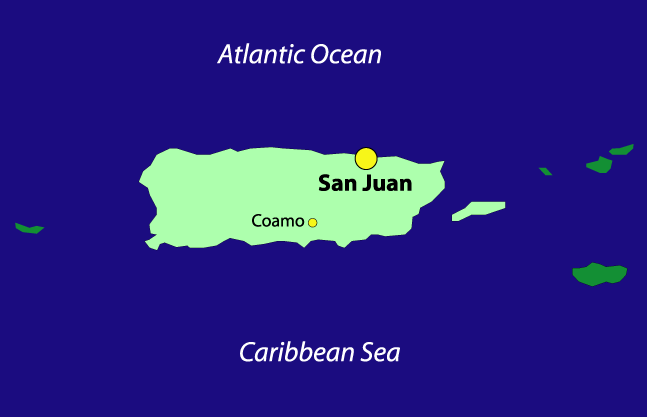
 Puerto Rico may be an economic territory of the United States, but its people are fiercely independent. Rarely will you find an American flag flying high, without a corresponding Puerto Rican flag nearby, sometimes flying even higher. The island’s capitol and largest city San Juan is a maze of old and new, with modern shops and restaurants, shanties, a fortress musuem, sky-scrapers and casinos, and shopping malls all standing in conjunction with each other. Maybe more so than any other place in the Caribbean, old mingles with new in Puerto Rico, and the streets of San Juan are just the beginning.