
Keep your money safe from thiefs or just figuring out exchange rates and other currency issues are important. Here are some ideas on how to make it easier for you. If you have any ideas to contribute please email us.
Currency and exchange issues
Never discount the usefulness of traveler’s checks–as old fashioned as they may seem, they can be a reliable means of exchanging currency and making purchases, particularly where credit card and ATM service is not available. Also, if you plan on traveling to only one country, change your currency before you go; many developing countries will only readily change more sought-after currency, so if you’re carrying Rands, Lira, or other, you may find it difficult to exchange these for the local currency.
If you plan of visiting more than one country and don’t want to juggle envelopes full of different denominations, try to find out what is the most easily changed–the U.S. dollar is widely exchanged throughout the world, so if your country’s currency is not as easy to change, it may be worth carrying U.S. dollars (or another common currency, such as the pound stirling) while you travel. This, naturally, applies to traveler’s checks as well as to cash.
Foreign ATM machines
No matter how globalized we think the world is, there are always going to be places where it’s just plain impossible to get cash in an emergency. Most first-world countries will have a well-developed network of ATM machines that accept cards issued by major banking services. But as you get into the developing world, you’ll inevitably run into a number of roadblocks. In many developing countries, ATMs can only be found in major urban areas such as the country’s capitol. And often these machines will only accept cards that were issued by that specific bank, leaving the rest of us tourists out of luck. And of course, the majority of the developing world still doesn’t have access to or an infrastructure for such luxuries as the automatic teller.
Before going on a trip, particularly to a developing country, be sure to do your research: find out what major credit cards are readily accepted, whether or not ATM machines are common, and if your card will be compatible with them.
Credit card problems
It’s not uncommon to find yourself in the middle of an extended trip with a credit card that no longer works, not because you failed to pay your bill, but because the card issuer froze your account for security reasons. This is not meant to be a malicious, or even inconvenient, act. In fact, it’s the credit card company’s way of doing its job: protecting you and itself from credit card fraud. Most card issuers monitor spending patterns, including average monthly bills and the general region of purchases made. When a traveler depends on his/her credit card away from home, this often raises a caution flag to the card issuer that someone may have stolen the card and is going on a “cross country” spending spree. They will thus freeze that account and wait for the card holder to call and confirm the theft or not.
To play it safe, always keep a record of your card issuer’s customer service number (and check for a separate number if you’re traveling overseas) so you can make that call when necessary, and alert your credit card company before going on a trip, so they don’t mistakenly freeze your account. It’s also a good idea to pay your bill in full before leaving on a long trip, so as not to have your credit card canceled because of delinquent payments.
Protecting your travelers checks
Traveler’s checks are often thought of as the safest and most reliable way traveling cash free. While this may be true, it doesn’t mean they can’t be lost or stolen and used by someone else. You cannot always prevent this from happening, but you can take measures to make it easier to report and replace lost or stolen checks. First, it helps to make copies of your travelers checks, or at least keep a record of their serial numbers. Second, make sure you know the denomination of your checks; it may be easier to get all of them in just one denomination, but keep in mind that you may have trouble cashing large denominations in certain places. Third, know the date and location you purchased your traveler’s checks and always get a phone number to report them lost or stolen. Doing these things won’t guarantee your security, but it will make your life easier in the event of such an emergency. Money conversion cheat sheet
A really handy, wallet-sized currency cheat sheet can be obtained online and printed with the touch of a few buttons. Log on to OandA.com (http://www.oanda.com) and select “Traveler.” Choose “Print Travelers Currency Cheat Sheet” and select the appropriate home and destination countries, then click on “Get My Cheat Sheet.” It’s that simple.
The Web site allows you to customize your cheat sheet according to various exchange rates (cash, credit, interbank, etc.), languages, and specific dates. And because it’s continuously updated, it’s also a convenient reference for keeping track of worldwide currencies.
Don’t attract criminals
The best way to keep from attracting a thief’s attention is to avoid wearing expensive looking jewelry and having cameras and other pricey items out for all to see. Keep your jewelry covered up or under lock and key at your hotel (most higher-end hotels will have a safe either in the room or at the reception desk). Cameras should be kept out of site as well–either tucked into bag or backpack when not in use, or better yet, strapped around your neck and under your jacket. Smaller point-and-shoot cameras will often fit into a pocket on the inside of your coat. Carrying large amounts of money
When carrying large amounts of money, especially in major cities where pickpockets are prevalent, it is a good idea to have a money belt that you wear underneath your clothing. Only keep small amounts in your pockets, keep everything else zipped up in the belt, including your passport and credit cards if possible. If you know you will be needing a credit card, you can take it out beforehand; this way, if you are robbed, most likely the thieves will only get away with a small amount of cash.
Money conversion
It’s a great idea, when dealing with money conversion, to carry a small pocket calculator. All you need to know is the exchange rate, and with one quick calculation you’ll know exactly what you owe. If you’re to embarrassed to pull out a calculator when browsing for gifts to bring home, you can write a out quick cheat sheet of the exchange for $1, $5, $10, $20, $50, and so on. This should make it easier to figure out the appropriate price of things without having to draw too much attention to yourself.


 need to go to work in order to survive, and often provide for their families.
 ‘One of my friends had gone to El Salvador the year before, and she said what an amazing experience she’d had, and that she was going back again’ says Lauren, reflecting on her 5 weeks spent volunteering.
 The children come to the program part time, when they are not working, and are able to come to this program free of charge, thanks to the support of volunteers.
 ‘When you picture a country like that when you go there, you see these kids out there selling things, but you don’t really have a personal relationship with them, so it just gave an incredibly different face and a different perspective on child poverty and child labor. It was really different when you knew the kid, and knew about their daily life, and had a relationship with them, rather than when it was just some faceless kid trying to sell you something. I have much more compassion, and respect, and understanding of their lives, and what that’s like.’
 Turkey is truly the meeting place of Europe and the Middle East. Although, generally, Turkey is considered a middle eastern country, its main hub Istanbul has a European feel with old world charm. This bustling city is a doorway into a country that has two distinct sides.

 Cross the Rio Grande heading south and you’ll enter the United States’ southern neighbor Mexico. Mexico is a land of many contrasts, from the northern desert to the rainforests of Chiapas, and everything in between. This is a country filled with history and culture–one look at the Mayan ruins is testament to that–but it is also rife with isolated beaches, towering volcanoes, and glitzy resorts in places like Acapulco and Cancun. Whatever your passion, you’ll likely find it in Mexico.

 Since 2500 B.C., the cultures that grew into the modern state of India have been involved in a wild dance of religion and politics that make the India of today one of the most colorful, culturally rich, hyperintense, and interesting places in the world. The culture, politics, and economic effects can run to such extremes, in fact, that tourists have often been divided in to “love” and “hate” groups when it comes to appreciating all India has to offer, in relation to the trials one must at times undergo to enjoy it.
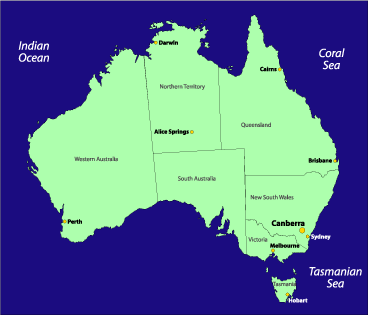
 My husband and I rented a beachfront, one bedroom apartment on the second floor of a three level apartment building. The apartment was very clean, bright, spacious and very well equipped, it was like being at home, we even had a laundry room just down the hall. We had a fabulous, unobstructed view of the ocean from our large shaded deck, and easy beach access through a public walkway on the front street. Noosa Heads offers a complete range of accommodations from the luxury beachfront suites to backpacker’s hostels and for the truly adventurous vacationers, why not rent a houseboat.
 There was no end to the activities that would keep us occupied during the day that is if we wanted something to do. We could take a walk through Noosa National Park, easy to find, we just followed the signs to the walkway. The view of the ocean and surrounding areas were spectacular; the walking trails were easy walking, it wasn’t necessary to be experienced hikers. We stopped along the path and listened to the birds singing in the trees, examined the different plants and wild flowers growing under the shade of the trees, and took many pictures.
 Suddenly we slowed our pace and over my husband’s shoulder he said “Look at the lizard”; now, I’m not a fan of lizards, but my curiosity told me that I needed to see what he was talking about. He took a step sideways off the path and there standing only a few yards away was large green lizard. The lizard was about five feet long from its nose to its tail, and while staring at us, it kept sticking out its long, skinny tongue. To me, it looked 8 feet long and it was probably going to eat us! The lizard animal walked off into the bush, minding its own business, and I was much relieved.