
 As near to out-of-this-world as only a few habited places on this earth are, Bangladesh challenges the visitor to find fulfillment despite excessive population density, national poverty, and robust environmental extremes. The rewards for those who take on such a challenge, though, are unique and intriguing insights into the rich regional Bengali culture and the current state of South Asian and global society.
One of the younger countries in the world, Bangladesh attained its independence from Pakistan in 1972. Dwarfed and almost engulfed by neighboring India, the country is on the very edge of South Asia, adjacent to Burma (Myanmar) to the east. Bangladesh is situated at the confluence and delta of three great rivers–the Ganges (Padma), Meghna, and Brahmaputra (Jamuna)–that together drain most of the Himalayan snowmelt, and this is the defining geographical feature of the nation.
 Population density is extreme countrywide: more than half the population of the United States lives in a land area smaller than many American states. The gross national product is heavily subsidized with foreign aid, and the average annual income is less than US$200.
War with, and independence from, Pakistan in the early 1970’s represents the dominant intracontinental political struggle of the past half-century, in which Bengalis established themselves as a distinctive ethnic group. The Cold War passed over the limited economic and military power of the region, but did align Bangladesh as an American aid recipient and potential ally.
Honored and nurtured, ancient and venerable prayer stupas and Bodhi trees scattered across the country represent the roots of the thousands-of-years-old Bengali culture. Cultural wealth was at a high point half a millennium ago, when ports on the Ganges and Brahmaputra Rivers traded wares from the interior of the Indian subcontinent with Africa and beyond. Isolated, crumbling palaces on the Ganges floodplain, and the cazbah walls surrounding urban areas, bear evidence of this prior cultural renaissance. Impacts of later colonization by the British are conspicuous: tea plantations continue to operate, and the colonial-era railway system is still the most dependable form of transport. The modern paradigm of globalization is hard on the indebted nation with its sparse infrastructure and high propensity for natural disasters. Although not a major economy of the world, Bangladeshis contribute heavily to the development of the global petroleum industry and also to United Nations armies.
Traveling in Bangladesh
Division of the Indian subcontinent 1948-50 established the current ethnic distribution, which, in Bangladesh, is approximately 88% Muslim, 11% Hindu, and 1% Christian. Politically, Bengalis tend to be moderately conservative, and the country does not suffer from ethnic and political tension so common in that region. Consideration of local customs, especially those regarding gender and religious roles, is recommended to those who wish to minimize their travel impact.
Although a high percentage of Bengalis know some English, actually communicating in English can only be done reliably in urban areas. The native language is Bangla, which has roots in the region and Arabic.
Iconic architecture is a highlight of the capital city–Dhaka–as are the high-density urban amazements such as markets and busy intersections. However, the pollution in any Bangladeshi urban area is powerful and pervasive, and includes trash and garbage as well as open sewers, noise, and vehicle exhaust.
Rural Bangladesh lies in seemingly stagnant transition between the 18th and the 21st centuries, a condition that has fallen upon much of the resource-poor postcolonial world. There are few wilderness or natural conservation areas, with the major exception of the Sundarbans in southwestern Bangladesh, where the graceful Bengal Tiger roams among immense coastal forests and mangroves. Rural villages tend to be well kept and productive, and people are inviting and interactive. To sit and have cha, a sweet creamy tea, and make conversation is the essence of traveling in Land of Bengal.
Bangladesh visas are valid for six months from the date of issue and are good for stays of one or three months.
Health concerns include cholera, dysentery, hepatitis, malaria and meningococcal meningitis. Consult your physician before visiting Bangladesh, and be aware of shots or medication that should be taken in advance of your trip.
Weather in Bangladesh
Monsoons from the Indian Ocean contribute to annual flooding, and the land area of Bangladesh reduces by about one-third each year from August to October. The best time to visit is from October to February–the cold season , when the weather is drier. Springtime in Bangladesh–roughly around April–can be very uncomfortable, with extreme heat and humidity.
Bangladesh Information
Name:
People’s Republic of Bangladesh
Population:
129 million (est.)
Government:
Republic
Square Miles:
55,598 sq mi (143,998 sq km)
Capitol:
Dhaka (pop: 8.5 million)
Official Language:
Bangla, English
People:
98% Bengali, 250,000 Bihari, tribals less than 1 million
Religion:
88.3% Islam, 10.5% Hindu, 1.2% other
Major products/industries:
Jute manufacturing, cotton textiles, food processing, steel, fertilizer, rice, jute, tea, wheat, sugarcane, potatoes, beef, milk, poultry
 Being so close the United States has made the Bahamas one of the easiest of the “island paradises” to visit. From its sprawling capitol Nassau, to its many smaller islands, the Bahamas have everything other Caribbean islands have and more. The Bahamas are made up of 700 islands and 2500 cays, which make it a wonderful place for sailing and diving, and with so many locations, you’ll never get bored.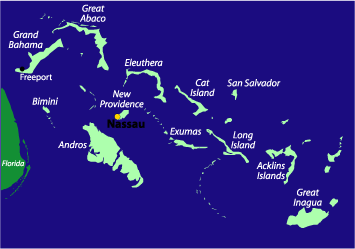

 The Portuguese gave this place some amazing architecture when they ruled and controlled the two islands and small mainland peninsula that is Macau. In fact, Macau was the first European settlement in the Far East. The Portuguese beat the Dutch and British by a hair’s breadth with their establishment of this well-positioned and soon-to-be-rich trading post. Hong Kong, Singapore, and Malacca followed many years later as the British, Dutch, and other nations established a presence in East Asia, but at the beginning, through Macau, Portugal ruled the roost.
 The Macau government makes seventy percent of its revenue from gambling and associated businesses. Most Hotels are built with gambling in mind and thus they boast many casinos and gambling dens on their premises, all with sumptuous rooms and services to woe the big spenders. Limousines carry the rich to their destinations of the evening. Hotels offer special packages for those with money to lose, and girls lie in wait to help spend money that prospectors may have had thoughts of keeping. Bars keep drinks flowing to loosen punters stiff fingers, fast food is lavished on the high rollers, and the large-muscled men have no qualms of throwing out the losers, arms aching as they ceaselessly open doors for the excited newcomer and help the defeated on their way.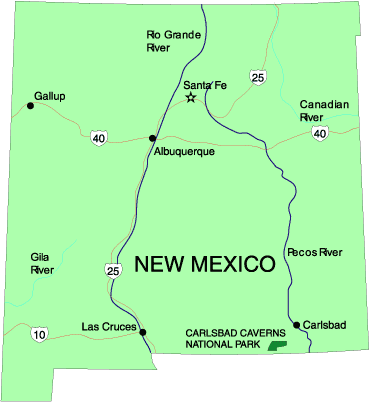
 For scientists, however, the caverns themselves are the most valuable natural resource. To the scientific community, the limestone caverns and surrounding mountains provide an opportunity to study an ocean reef from the inside. Though the reef was made of mostly sponges and algae, which have long since disappeared, live bacteria still grows in the underground water pools, and well-preserved fossils have been found in the rock. Unfortunately, everyday tourists do not get to dig for fossils or collect bacteria samples. Instead, they come to see the effects water can have on solid rock.
 Like an elaborate cathedral created by nature, the main area of the cavern is called The Great Room. It is the largest natural underground chamber in the United States, with appropriately named formations, such as Doll’s Theater and Whale’s Mouth.
 There is a place in Puerto Rico where a panoramic view of Olympus-like mountains, veiled by the shadows of clouds, encircles a town of oft-neglected interest and history. It’s a place where lush greenery grows as far as the eye can see and the golden hands of the sun touch every street corner. This place is called Coamo, just a short drive south of San Juan and northeast of Ponce traveling on route 14. The tranquil valley in which Coamo rests is largely unaffected by the hustle and bustle of the major Puerto Rican tourist centers and appeals to those who prefer “the path less traveled.”Located in the interior of the island, Coamo is a nature lover’s paradise. Driving along meandering country roads will get you so close to the feet of mountains that you can practically stick your hand out of the car window and touch them. Concrete homes painted in pastels of peach, lime, and lavender dot the terraced landscape like rugged steps, each one higher than the next. I was so transfixed by the towering majestic scene before me that a dull cramp settled at the base of my neck from looking up. But I was hypnotized. If you enjoy nature, as I do, consider bringing a neck brace. The tiny sedan in which my companion and I traveled whined like a stubborn pack mule as we coaxed it over the steep hills and dips that snaked before us.
 Coamo is an amazing place. The third oldest city in Puerto Rico, it is steeped in history and rich tradition. Founded in 1579 by Cristóbal y Blas de Illescas, the town was originally called San Blas de Illescas. The current name comes from the Taino chief Coamey. At the centerpiece of the Plaza de Mercado is the famous Iglesia de Illescas, a Catholic church initiated by Friar Diego de Salamanca in 1616. It was the first church of its kind to offer religious service to the small community, and today it stands as the cornerstone of the city, with its blinding, pristine façade gleaming in the fierce Puerto Rican sun. The Coamo Museum is just a few yards away from the church. Within its walls are housed interesting facts about the town, the indigenous Taino culture, and of course the Spanish influence with regard to modern Puerto Rican culture.
 After all that sightseeing and mingling with the locals, it was time for a little R&R. Coamo has that covered too. For golf fanatics, one must visit the beautifully kept Coamo Springs Golf Club and Resort. The eighteen-hole course is the only one of its kind in southern Puerto Rico. The weather is nearly always perfect and the fairways are from heaven. If golf is not your style, you can take a jaunt to the famous Baños de Coamo. Used by the natives of Coamo for its mythical therapeutic powers, the baths of Coamo are thought to be the “Fountain of Youth” for which Conquistador Juan Ponce de Leon searched so frantically. There are two entrances to the springs. One is for the public and is free; however, it not well maintained and is often crowded by the locals who use it as a meeting place to discuss civic events and politics. The other entrance is through the parador Los Baños de Coamo. The forty-eight-room hotel was once one of Puerto Rico’s most upscale resorts. Current rates range from US$62-$81 per night. The rooms are not luxurious by any stretch of the imagination, but the accommodations are fair considering the price. If you do not wish to stay at the hotel you can still take advantage of their baths for nominal fee.
 But this summary describes a different place equally well, a place that is several years further down that path than anywhere on the Pacific coast, and a place where a recent reporting trip brought me into close contact with the two-tier tourism economy: Cuba.
 The Soviets had given the Cubans a stunningly good price for its sugar, accepting Cuba’s sugar in exchange for Russian oil. When the Soviet Union collapsed, Cuba found that selling its sugar at the world market price would fetch less than twenty percent as much oil as it had received before.
 The move was tinged with irony because the hard currency circulating in Cuba is issued by a government that has been trying for forty-four years to bring about regime change on this Caribbean island, by methods ranging from invasion and economic strangulation to outright assassination.
 As an American hailing from a part of the country undergoing similar (if much less drastic) change, witnessing this economic divide gives me pause, and rightly so. Many rural areas on the Pacific coast of Canada and the United States have also seen the disparity among incomes widen in recent years. Old sources of livelihood have dried up, and new forms of income–arising from transfer payments from outside the region and from the service economy–have become more significant.
 Although the Pacific Northwest doesn’t face quite so extreme a situation, the parallels are worth noting. Communities bear a social cost when talented entrepreneurs harvest the tourist dollar through t-shirt shops, ice cream stores, and charter fishing, instead of building enterprises that serve local needs or yield higher-wage jobs in manufacturing or value-added processing. What’s more, many of the goods that feed the tourist economy come from outside the area, a factor that reduces the net benefit to the community from the tourist trade.
 In most cases, however, these programs pale in comparison with the Cuban methods of “milking†tourists. (The beaches of Oregon, for instance, will never draw sun worshippers in the same numbers as the sands of the Caribbean.) But Cuban innovations in the harvest of the tourist dollar may hold valuable lessons even across different climates and economic systems.
 It’s not unlikely this will happen to you at some point in your life–whether they contact you through the mail, solicit by telephone or, like my wife and I, you make the grave mistake of entering in a “contest” at a trade show–you may one day have someone try to sell you a timeshare. For us, it was a flyer at a boat show that led to a phone call announcing we had “won” a vacation. That’s the hook: a free dinner, cash, or vacation… one time I was even offered a car. All we had to do to was spend a few hours at a presentation for timeshare opportunities–with no obligation to buy–and the rest was on the house. The woman on the other end of the phone line explained, for a few hours of our time learning about opportunities in the timeshares, we would receive two days in Orlando, Florida, with complementary tickets to the Universal Studios theme park, plus a two-night cruise to Nassau, Bahamas, and two nights in Fort Lauderdale. All we had to do was pay for airfare, pick a date, and everything else was covered. Seems like a win-win situation, right?
 High on the itinerary of any traveler to South America is Peru, the third largest country in the continent. Peru is the home to several ancient Andean civilizations — most notably the Incas, who ruled until the Spanish invasion in 1533.